
.png&w=1080&q=75)

.png&w=2048&q=75)
The Two Peaks in HBR's Culture Map: Reading the Eight Styles Beyond the Chart

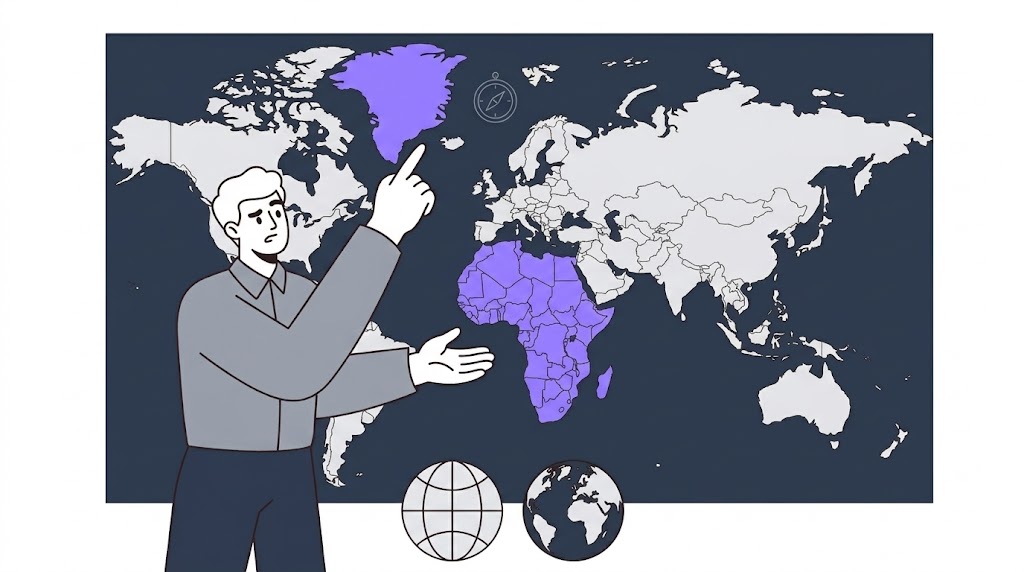 Pull up a world map and Greenland looks about the size of Africa. In reality, Africa is nearly 14 times larger. Most world maps use the Mercator projection — a way of unfolding a round Earth onto a flat sheet that stretches land near the poles and compresses land near the equator. The map isn't wrong, exactly. It's a flat surface trying to hold a sphere.
People who spend their lives looking at that map carry an inflated Greenland in their heads. Then one day they see the real proportions, and the world looks different.
Something similar happens with the way we look at organizational culture.
Eight Equal-Looking Boxes
In a 2018 Harvard Business Review article, Boris Groysberg, Jeremiah Lee, Jesse Price, and J. Yo-Jud Cheng introduced an Integrated Culture Framework that maps corporate culture onto two axes.
The horizontal axis tracks how people relate to one another. On the left is independence — autonomy, individual action, competition. On the right is interdependence — coordination, teamwork, group behavior. The vertical axis tracks how organizations respond to change. On top is flexibility — openness, innovation, variety. On the bottom is stability — consistency, predictability, hierarchy.
Eight styles sit on this grid, arranged clockwise from the top: Learning (Tesla), Purpose (Whole Foods), Caring (Disney), Order (the SEC), Safety (Lloyd's of London), Authority (Huawei), Results (GSK), and Enjoyment (Zappos).
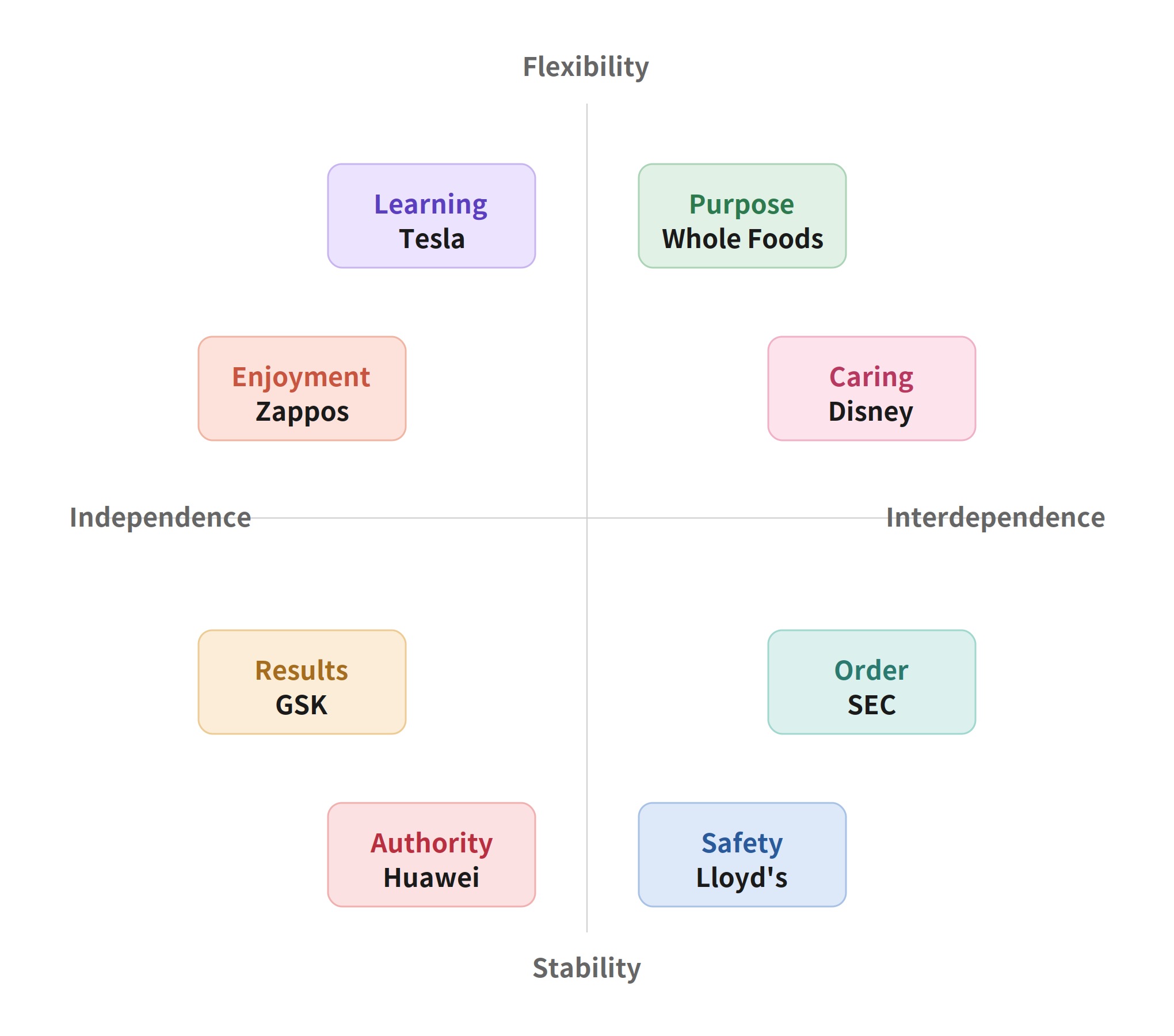
Laid out this way, the eight boxes look like equal options on a menu — eight directions a company can choose from. But there's one thing the layout doesn't show: where companies actually cluster on the grid.
Where Companies Actually Cluster
The researchers surveyed several hundred organizations and tracked how often each style ranked in a company's top two. The numbers are striking:
Results — 89%
Caring — 63%
Order — 15%
Purpose — 9%
Safety — 8%
Learning — 7%
Authority — 4%
Enjoyment — 2%
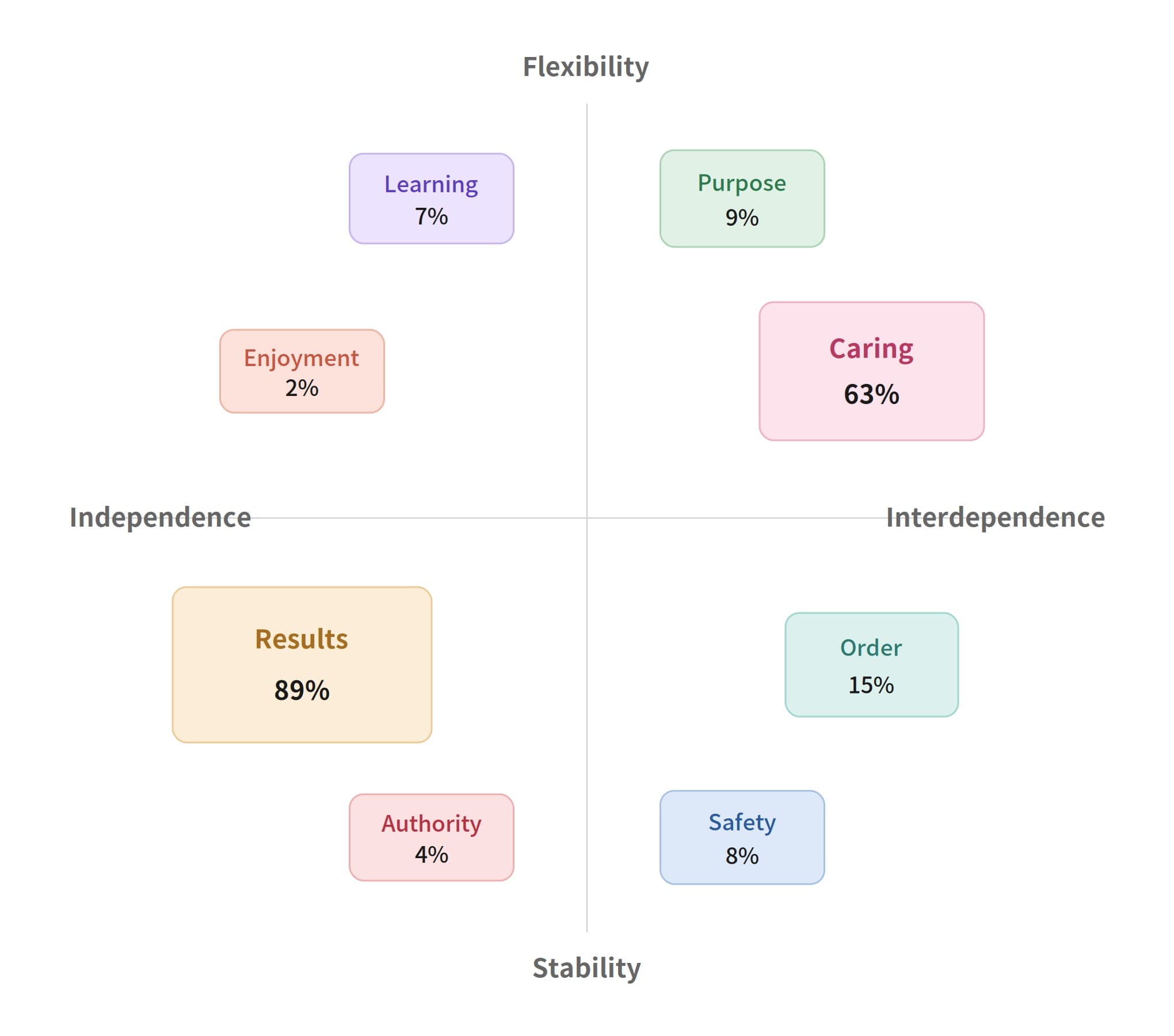
Nearly every company puts Results in its top two. More than half put Caring there as well. On the framework chart, the two styles sit on opposite sides — Results in the lower-left (independence and stability), Caring in the upper-right (interdependence and flexibility) — yet both rise as massive peaks above an otherwise quiet landscape.
Enjoyment (2%), Authority (4%), and Learning (7%) are statistically rare territory.
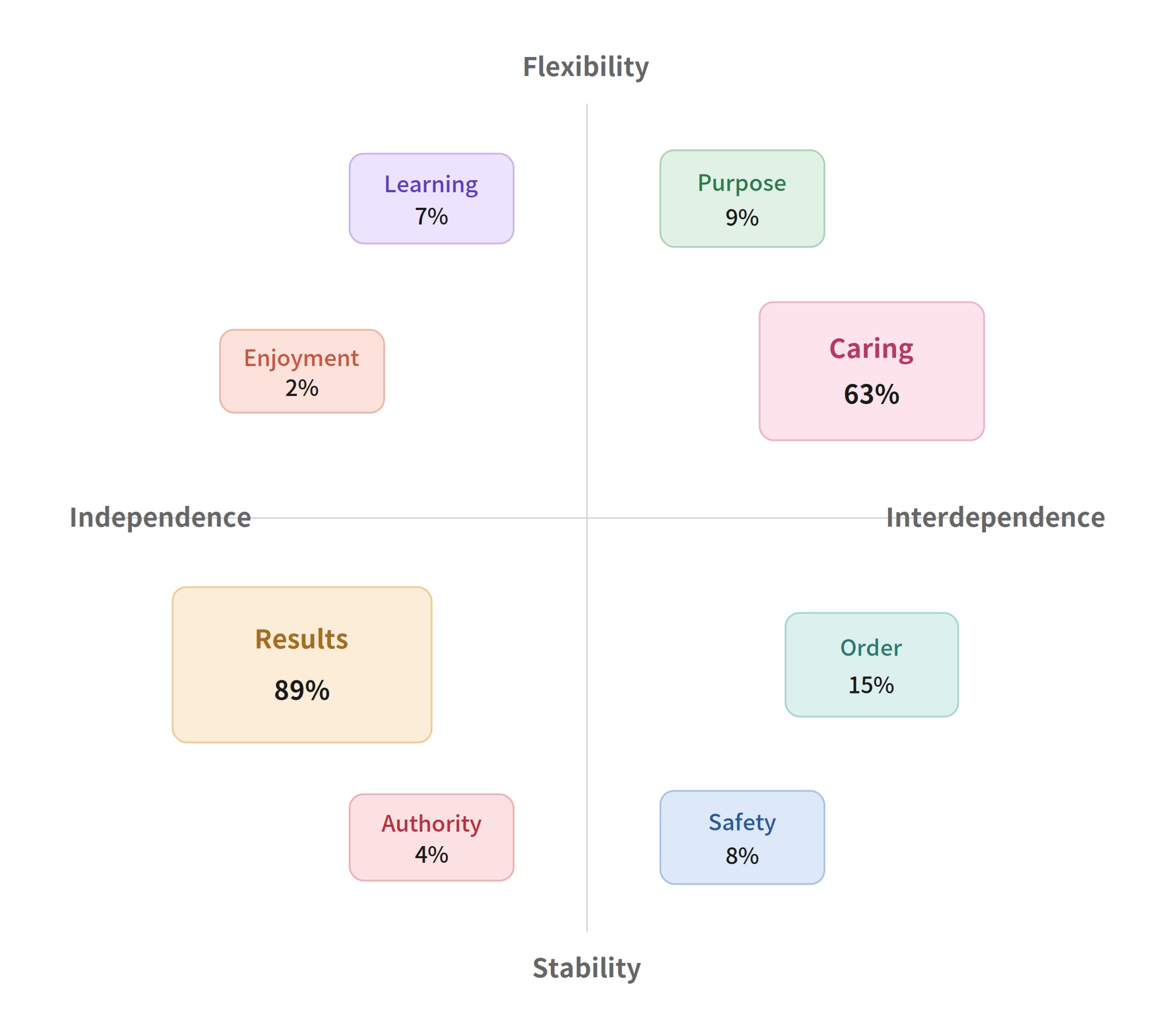
Redraw the same chart with box sizes scaled to actual distribution and the whole landscape transforms. Results and Caring dominate. The remaining six styles shrink into small footprints scattered around them.
Why Some Companies Stand Apart
Knowing the distribution changes how we read the companies we hear most about.
Zappos (Enjoyment) operates in territory occupied by 2% of organizations. Tesla (Learning) — 7%. Huawei (Authority) — 4%. Patagonia (Purpose) — 9%. We don't keep hearing about them simply because they're well run; plenty of companies are well run. We hear about them because they sit in statistically rare territory, and they got there by choice.
The other 89%+ live inside the Results-and-Caring peaks. The corporate form has gravity. The basic requirements of running any company — generate revenue, hold a team together — pull naturally toward Results and Caring. Zappos and Tesla stand out because they chose to leave that gravity behind and stake a position elsewhere.
Beyond the Analysis
Once you've seen how the landscape actually distributes, the chart reads differently. You're no longer looking at eight equal boxes. You're looking at a terrain — two ridges with a wide scatter of smaller positions around them.
Place your own company on this terrain and the picture gains a layer. Is the company sitting where the corporate form naturally pulls it? Or did someone deliberately leave that pull to stake a different position? Both kinds of position carry meaning.
But locating your company on the chart is only the beginning. The more interesting question — the one worth taking back to work — is: what direction is the company actually moving toward, and would everyone inside give the same answer?