
.png&w=1080&q=75)
.png&w=2048&q=75)
From Slack, Notion, Credentials, and Peer Feedback to One Resume

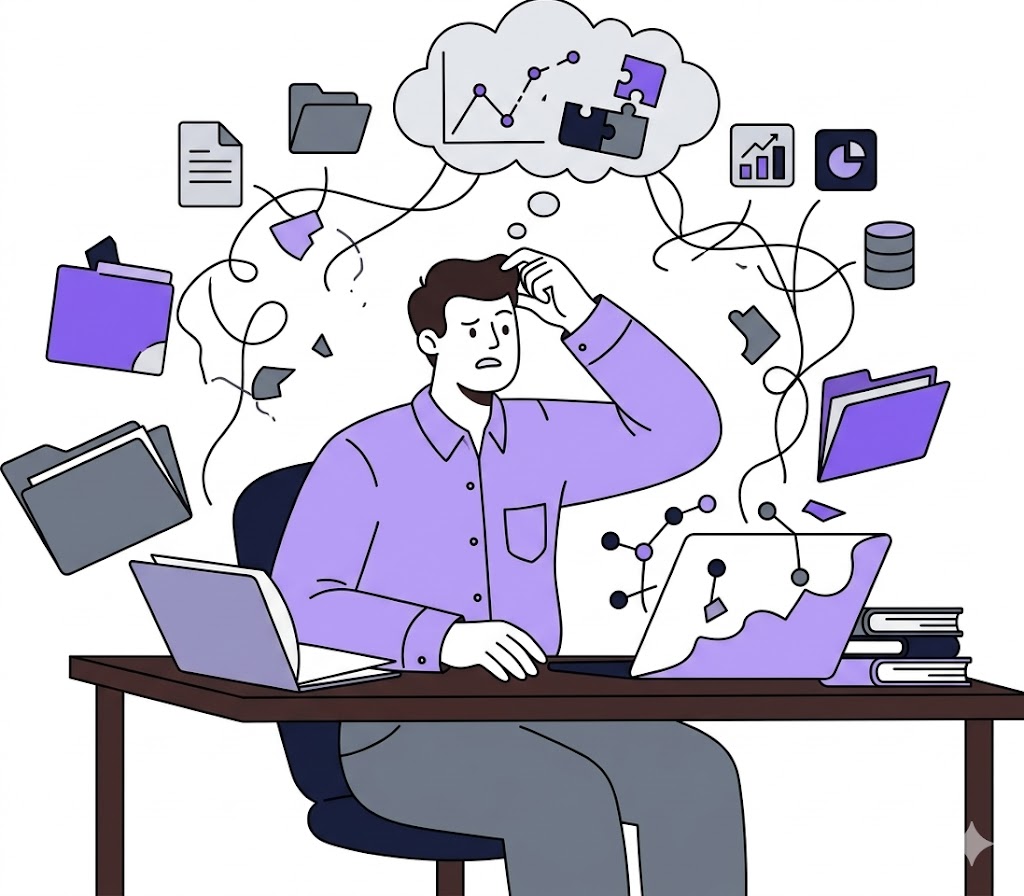
If you've ever sat down to write your resume, you know the moment that hits hardest. You try to recall what you actually did, and the information isn't sharp in your head. How many users did you interview during that hackathon, exactly? By how many milliseconds did p95 latency drop in your internship? What did that teammate say about you in the project retro? It's all somewhere — but not in one place.
Writing a resume is, in the end, the work of pulling scattered information onto a single page. That's the hardest part.
A Resume Needs Five Kinds of Information — All in Different Places
When you actually break down what goes into a single-page resume, it falls into five categories. And those five categories live in five different tools, in five different formats, in five different places.
Project records and process — Slack threads, Notion pages, group chats, GitHub pull requests
Quantified metrics — meeting notes, analytics dashboards, slide decks, Discord channels
Peer feedback — DM replies, email threads, Slack messages
Credentials — transcripts, language test scores, certifications, license PDFs
Your working style — not really written down anywhere
A resume is complete only when all five are pulled into one place. That's why getting started always involves so much digging.
What an Unconsolidated Resume Signals
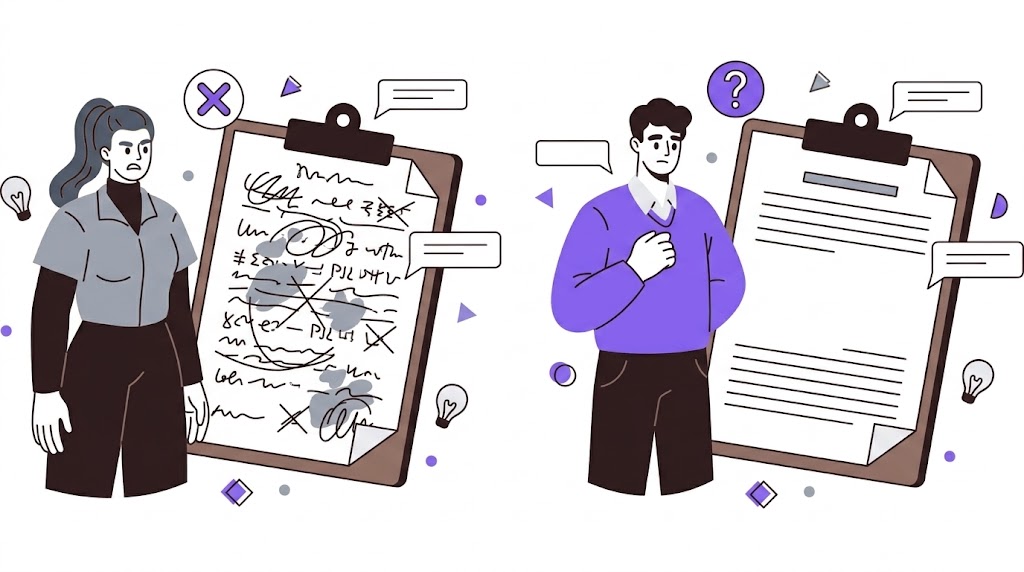
When the source material doesn't come together cleanly, two problems show up on the page:
Omissions — work you actually did but can't recall in the moment
Imprecision — numbers and timelines blur, so you settle for weaker phrasing
And there's a third thing recruiters read into it. The way your resume holds together tells them how you tend to handle information. The act of consolidation is itself a signal — your ability to organize your own record is a small proof of how you'll handle organized work on the job.
Can't You Just Hand Everything to AI?
You might think the fix is to dump all the scattered material into ChatGPT and let it sort things out. In practice, this hits limits:
Token caps — too much input and the front gets truncated
No direct tool access — Slack, Notion, Linear all require manual copy-paste
Lost context — AI loses track of which project, which phase, which role
Partial credential integration — transcripts and certifications don't fit clean text formats
AI is a good tool, but not a tool for consolidating scattered material in one pass. AI works on the information you give it. When that information is spread across five places, giving it all at once is the actual problem.
When You Run a Project on Perplz, the Project Becomes Your Resume
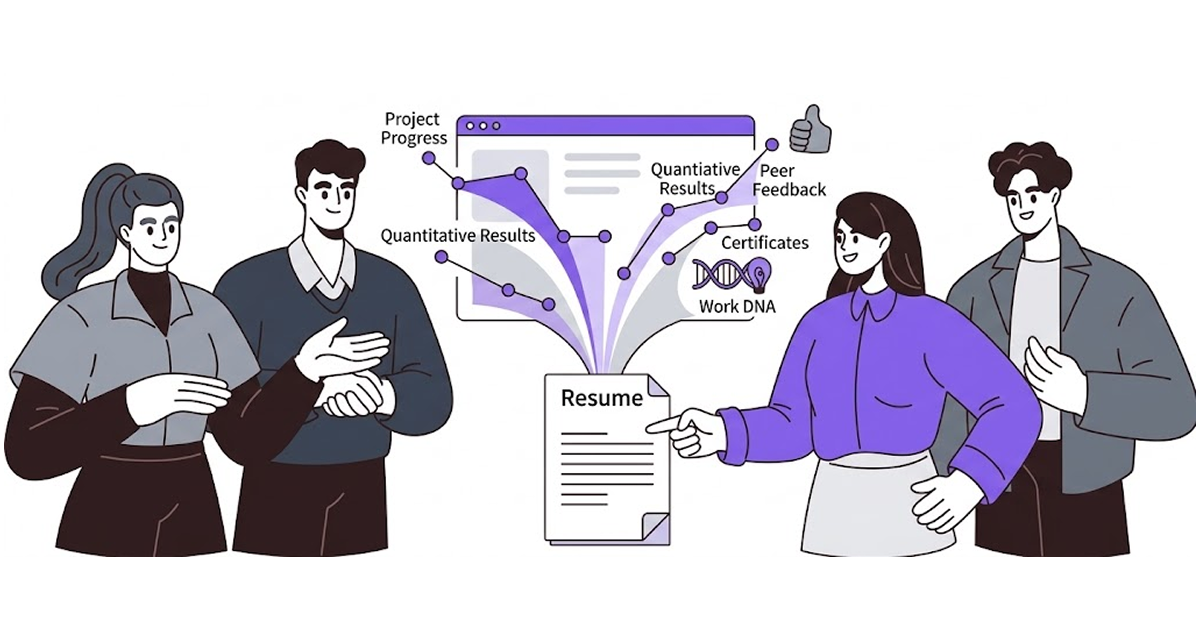
This is where the whole series lands in one place. Perplz isn't a "tool for writing your resume separately." When you run a side project or team project on Perplz, the process itself accumulates into the five kinds of information a resume needs.
Project records and process — your project history, timeline, team size, and role accrue as you work
Quantified metrics — measurable outcomes get captured naturally during the project, not reconstructed afterward
Peer feedback — when a project wraps, your collaborators' feedback comes in automatically
Credentials — upload your transcripts, language scores, or certification PDFs and AI integrates them into your record
Your working style — your collaboration patterns get mapped to one of eight Work DNA types, giving recruiters an objective frame for the kind of teammate you are
By the time a project ends, all five are already sitting together. The "writing the resume" step disappears. AI takes the gathered material and produces your professional summary and Career Story for you. You're not starting from a blank page.
Perplz uses AI not as a content generator, but as a tool that builds your resume alongside your work. That's why what comes out looks fundamentally different from a resume you'd produce by handing ChatGPT a list of your bullet points.
What Perplz Resume Is Really For
There's one more thing to flag. Perplz Resume isn't built around the goal of producing "the perfect single-page deliverable."
What actually happens once the resume comes together quickly is that you move into the next step — meeting the next team you'll work with on Perplz. The weight of the product sits not on the resume as an output, but on the resume as a starting point for finding the people you'll work with next.
A resume isn't an ending. It's a beginning. You start from a single page that naturally shows who you are when you work with others, and from there you move into the next project, the next team. That's the place Perplz is trying to build.
Closing the Series
If we compress six days of writing into one line: a resume is a record of what you did, and a record of who you worked with and how. Both have to be there for the resume to feel dimensional, and both come down to where you store the work as it's happening.
When the tool fills that storage in for you, you don't start from a blank page anymore.
The Full Series
Part 1 — 5 Traps Job Seekers Fall Into When Writing AI Resumes in 2026
Part 2 — The AI Resume Difference Recruiters Actually Recognize
Part 3 — The First Line That Decides Your Resume
Part 4 — You Don't Need Big Numbers
Part 5 — The One Line AI Can't Write
Part 6 — From Slack, Notion, Credentials, and Peer Feedback to One Resume ← this post
Thanks for following the series. Reading from Part 1 in order makes the flow click more clearly.
One More Thing
When you start a side project or team project on Perplz, the resume builds itself with the work — AI-generated, from the project itself, with no separate "resume writing" step.
Find your team. Build real projects together. Skip the part where you sit down to write a resume.
Project records, peer feedback, working style — auto-assembled into a resume in about a minute. → [Try Perplz]