
.png&w=1080&q=75)

.png&w=2048&q=75)
The First Line That Decides Your Resume — 4 Pieces of a Career Story

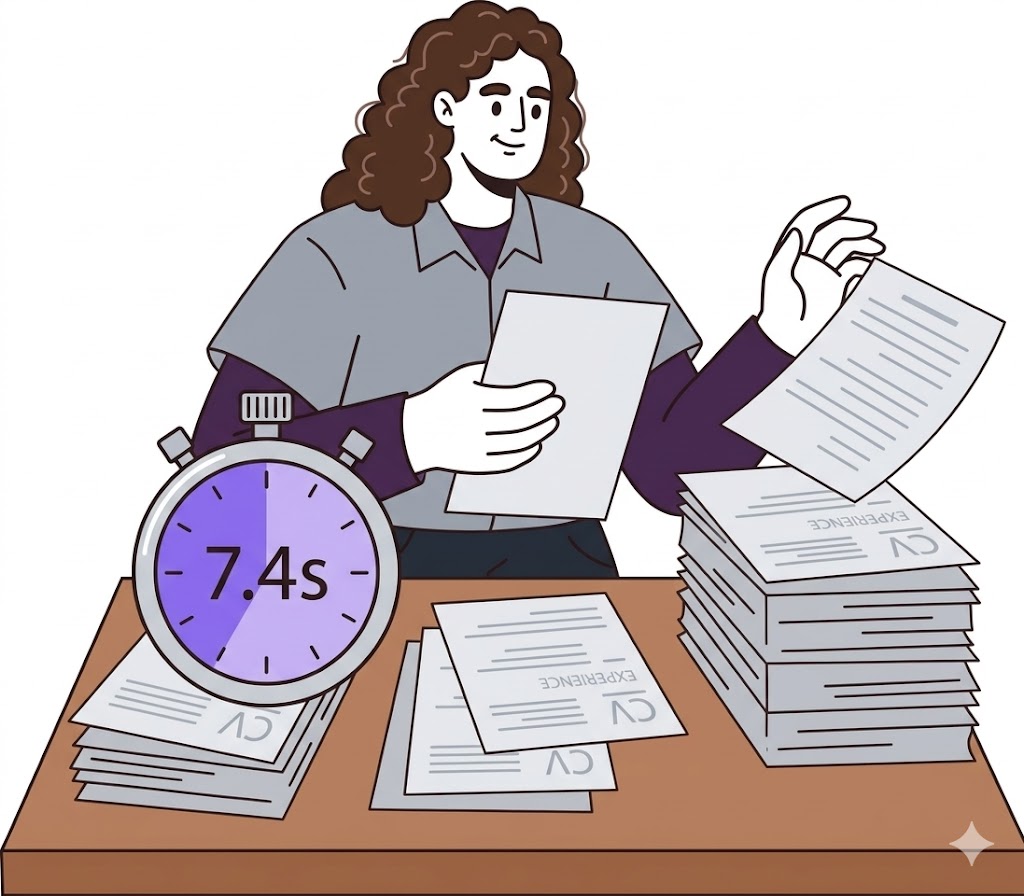
A recruiter decides their first impression of your resume in an average of 7.4 seconds. That number comes from Ladders' eye-tracking research, and most of those seconds are spent on the first thing they see — your Career Story (also called a professional summary, resume headline, or "About Me" depending on the template).
But when you sit down to actually write that first line, it's the spot that locks up. You have to define yourself in one paragraph. Even with AI, what comes back is usually something like "Diligent and detail-oriented professional with a passion for innovation" — and lines like that are the fastest to get filtered.
This post breaks down the four pieces that need to be in your Career Story. Whether you write it yourself or hand it to AI, when these four are filled in, the first line starts to sound like you.
Why Recruiters Stop at the First Line — Generic Phrasing

The most common Career Story opening recruiters see looks like one of these:
— "Diligent and detail-oriented OO professional"
— "Passionate new graduate with a drive to learn"
— "Hardworking and motivated OO with experience in..."
— "Recent grad with diverse experiences and strong communication skills"
What these lines share is that they could go on anyone's resume. If you could swap the company name in your application and reuse the same line, that's a red flag. TopResume's career experts make exactly this point: a resume summary that could apply to anyone is the first thing recruiters skip past.
What recruiters actually want to know in those 7.4 seconds is "Who is this person? What domain do they work in, and who are they within it?" Generic phrasing answers none of that. The eyes move down the page, then to the next resume in the stack.
One more thing. When you hand AI a Career Story task, generic phrasing comes up even more often. AI outputs the average of its training data, so without unique input from you, the result converges on the safest possible sentence. This is the same trap we covered in Part 2 — same root cause.
Four Pieces That Make a Career Story Yours
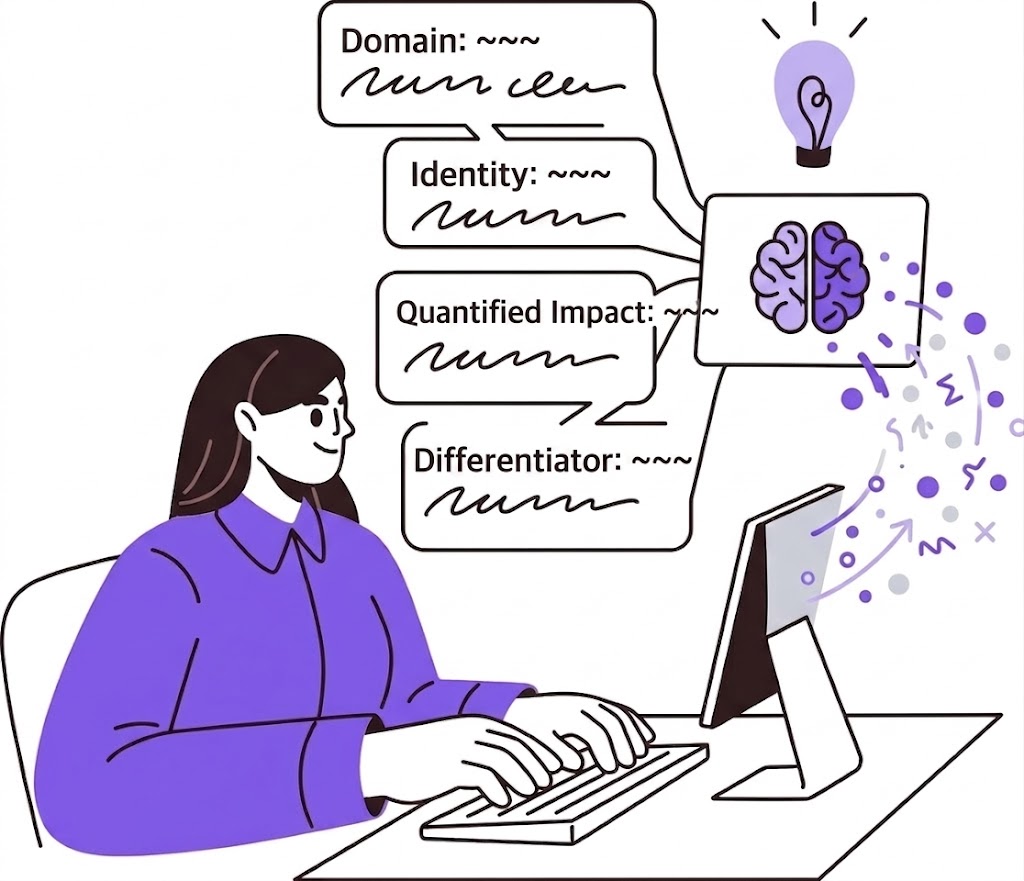
These are the four pieces a Career Story needs. They map directly to what recruiters are looking for in that first impression.
· Domain — what field, industry, or problem do you work on
· Identity — who are you within that domain (role, approach, style)
· Quantified Impact — one or two numbers that prove the identity
· Differentiator — what separates you from others in the same domain
When these four are filled in, the Career Story shifts from "a sentence anyone could write" to "a sentence only you could write." Let's go through them one by one.
1. Domain — What field do you work on
The first piece is naming the field, industry, or problem you actually work on. Without it, all you've got is a job title — "designer," "developer" — with no clue what part of the job title you're strong in.
Weak: "I'm a designer."
Strong: "I design productivity tools for remote workers."
Same designer, but the second line tells you which users and which problem this person actually thinks about.
2. Identity — Who are you within that domain
The second piece compresses your working style, your role, your approach into a single line. Without it, you've named the domain but blurred who you are inside it.
Weak: "I'm a backend engineer."
Strong: "I'm a backend engineer who's strong on performance optimization in payments and fintech."
"Strong on performance optimization" is the identity. Same backend engineer, but now we know where their center of gravity sits.
3. Quantified Impact — Numbers that prove the identity
The third piece is at least one number that backs up your identity. As an entry-level candidate, you might worry that you don't have impressive numbers yet — but small numbers from hackathons, internships, side projects, and student organizations work fine.
Weak: "I have experience improving user experiences."
Strong: "In a recent hackathon, I ran 12 user interviews to surface three core friction points and iterated on the prototype to lift usability scores by 23%."
Numbers turn an assertion into evidence. They make the "I am" feel like "I actually did this." Part 4 of this series goes deep on how to pull these numbers out of your projects.
4. Differentiator — What sets you apart in the same domain
The fourth piece captures what makes you different from others working in the same domain. This is the hardest to write, and the most powerful when done right.
Weak: "I'm a user-focused designer."
Strong: "I'm a designer who breaks decision deadlocks between PM and engineering by bringing two or three quick mocks to the conversation."
Even with a hundred designers chasing the same role, this one line draws a clear shape around you. Differentiators usually come from peer feedback or from specific moments of collaboration. Think about the role you naturally play on a team when things get stuck — that's often where the differentiator lives.
Before / After
This series follows two fictional job seekers — Pearl Kim, a design student building hackathon products, and Jasper Brooks, a CS student with open source contributions and a Series A fintech internship. Same person, same experience — but watch what happens to the Career Story when the four pieces are filled in.
Pearl Kim (Design) — Aspiring Product Designer
[Before]
"Aspiring designer passionate about user-centered design. I've explored design across various team projects."
[After]
"I'm a product designer who focuses on productivity tools for remote workers. Drawing on a recent hackathon where I ran 12 user interviews to surface three friction points and lifted prototype usability by 23%, I work as a designer who unblocks PM-and-engineering decisions with two or three quick mocks."
Domain (productivity tools for remote workers), Identity (product designer), Quantified Impact (12 interviews, 23% usability lift), Differentiator (unblocking decisions with quick mocks) — all four packed into a single paragraph.
Jasper Brooks (CS) — Aspiring Backend Engineer
[Before]
"Growing backend engineer with experience across various projects."
[After]
"I'm a backend engineer who's strong on performance optimization in payments and fintech. Coming off a Series A internship where I cut payment API p95 latency from 800ms to 320ms, I work as an engineer who unblocks hard technical decisions by laying out trade-offs in a table so the team can converge quickly."
Domain (payments and fintech), Identity (backend engineer strong on performance), Quantified Impact (800ms → 320ms), Differentiator (trade-off tables for team convergence) — all four pieces in a single paragraph.
A Prompt Template for AI
Once you've organized the four pieces yourself, AI can give you back a Career Story that sounds like you, not a template. Copy this into ChatGPT or Claude and fill in your own information.
————————————————————————
I'm a [major/role] job seeker, and I want to work in [domain]. Write me a one-paragraph Career Story for the top of my resume.
Domain: [the field, industry, or problem you want to work on]
Identity: [who you are within that domain — role, approach, style]
Quantified Impact: [one or two numbers that prove the identity]
Differentiator: [what sets you apart from others in the same domain]
Conditions:
- Two or three sentences
- No filler adjectives like "diligent," "passionate," "hardworking," "driven"
- Include specific domain, numbers, and differentiator
- Should define who I am in a single sentence
————————————————————————
Pearl's prompt
I'm a design student and a job seeker, and I want to work on productivity tools for remote workers. Write me a one-paragraph Career Story for the top of my resume.
Domain: Productivity and focus tools for remote workers
Identity: A product designer who finds friction points through user research and validates fast with prototypes
Quantified Impact: 12 user interviews and 23% usability lift in a recent hackathon
Differentiator: Unblocking PM-and-engineering decisions by bringing two or three quick mocks to the conversation
Jasper's prompt
I'm a CS student and a job seeker, and I want to work on backend systems in payments and fintech. Write me a one-paragraph Career Story for the top of my resume.
Domain: Backend performance optimization for payments and fintech
Identity: An engineer who owns latency and reliability end-to-end
Quantified Impact: Cut payment API p95 latency from 800ms to 320ms (60% reduction) during Series A internship
Differentiator: Laying out hard trade-offs in a table so the team converges quickly on technical decisions
The Piece That Locks Up Most Often — Quantified Impact
When you actually try to fill in the four pieces, there's usually one spot that locks up: Quantified Impact. "How many users did you interview in that hackathon, exactly?" "By exactly how many milliseconds did p95 drop in your internship?" Are those numbers still sharp in your head?
Most of the time, they aren't. Those numbers live scattered across Slack threads, Notion pages, Linear tickets, Discord servers, and GitHub pull requests. Part 4 of this series covers how to pull them out of those tools and how to connect them to process — the story of how you actually solved the problem.
Today's Takeaways
· Recruiters decide their first impression of your resume in 7.4 seconds. Most of that lands on the first line.
· "Diligent and passionate" sentences could go on anyone's resume — and they're the fastest to get filtered.
· Four pieces that make a Career Story yours: Domain / Identity / Quantified Impact / Differentiator.
· Even when you hand the task to AI, you need to organize the four pieces yourself first — that's how you get something that doesn't sound generic.
· The piece that locks up most often is Quantified Impact. We cover that in Part 4.
The Full Series
This series publishes one post a day, six days in a row.
· Part 1 (May 9, Sat) — 5 Traps Job Seekers Fall Into When Writing AI Resumes in 2026
· Part 2 (May 10, Sun) — The AI Resume Difference Recruiters Actually Recognize
· Part 3 (May 11, Mon) — The First Line That Decides Your Resume ← this post
· Part 4 (May 12, Tue) — Quantifying Your Results: Numbers and Process on a Resume
· Part 5 (May 13, Wed) — The One Line AI Can't Write: References Inside Your Resume
· Part 6 (May 14, Thu) — From Scattered Slack, Notion, and PDF Records to a Single Resume
Each part gets linked back to this page after it goes live.
One More Thing
Up next: Quantifying Your Results: Numbers and Process on a Resume (Part 4, May 12 Tuesday)
What if Quantified Impact and Process were building themselves up in the background as you worked? That's what Part 6 is about. If you want a preview now — find your team, build real projects together, and build a resume recruiters actually read. → [Try Perplz Resume]