
.png&w=1080&q=75)

.png&w=2048&q=75)
The AI Resume Difference Recruiters Actually Recognize in 2026

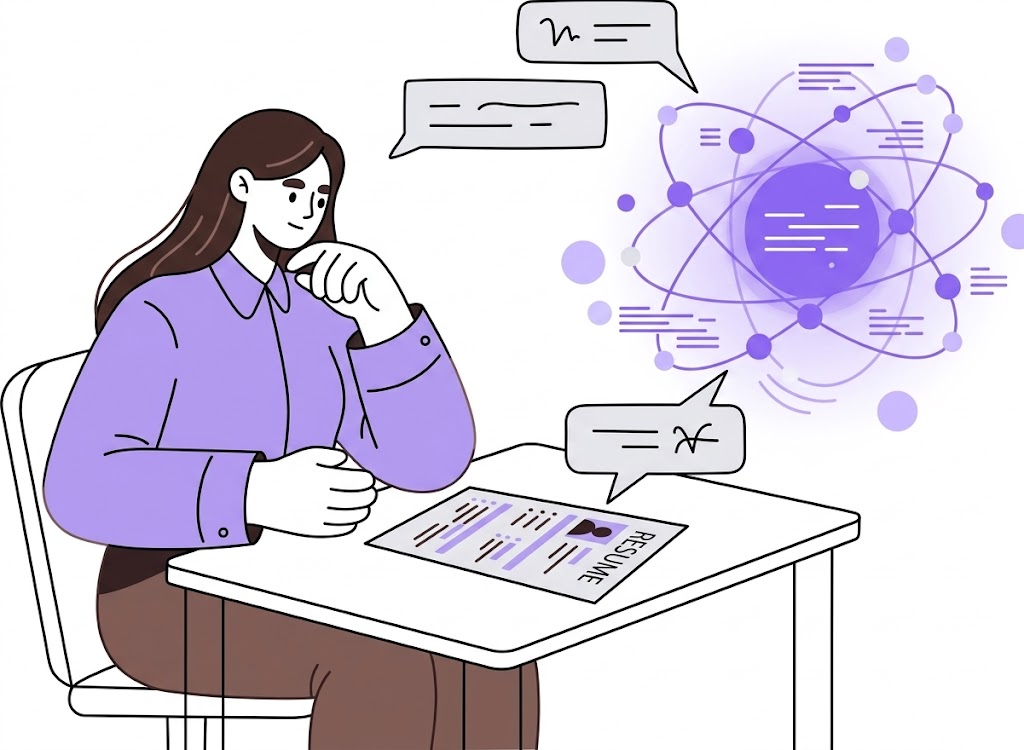
These days, your resume gets read by people and by AI.
According to a SHRM survey from early 2026, 43% of large employers have built AI detection tools into their hiring pipeline. AI scans your resume before any human does. If it looks suspicious, it never reaches a recruiter's desk. 49% of hiring managers will auto-dismiss the moment they suspect AI involvement (Resume.io, n=3,000).
You might read that and conclude: don't use AI. That's the wrong takeaway. Roughly half of job seekers already use AI to write or optimize their resumes (Resume Genius, 2025). On the other side of the table, 82% of companies now use AI to review them (ResumeBuilder, n=948). AI is already everywhere — on both sides.
The real point: same tool (ChatGPT, Claude, Copilot), wildly different outcomes. One version reads as "AI-automated boilerplate" to both the detection tool and the recruiter and gets filtered out. The other reads as "this person's actual story" to both, and makes it through.
What makes the difference isn't AI. It's how you use it.
The job seekers who hear "Did you use AI for this?" from their mentors — they didn't get caught because they used AI. They got caught because they didn't use it well enough. They handed AI too little input and expected too much output.
What AI Detection Tools — and Recruiters — Spot First
The very first red flag in any AI resume is missing detail. Career site Enhancv calls this out clearly: AI-generated resumes stack flashy modifiers ("innovative," "strategic," "results-driven") on top of each other, with nothing specific about which tools you used, which obstacles you ran into, or which problem you actually solved.
Detection tools spot the pattern first. Recruiters spot it second. For entry-level resumes, lines like these set off alarm bells:
— "Carried out multiple cross-functional projects."
— "Participated in a capstone team initiative."
— "Gained diverse internship experience across industries."
— "Developed strong teamwork and communication skills."
What these lines share is that there's no trace of the person who wrote them. They'd fit any resume, anywhere. To a detection tool, that reads as a "statistical pattern." To a recruiter, that reads as "a line I've seen a hundred times this week."
This isn't theoretical. WasItAIGenerated's 2026 analysis estimates that 78% of job applications now contain AI-generated content. ATS systems are being trained on the patterns. One documented case: a candidate had a job offer reconsidered three weeks before their start date after HR identified "AI writing patterns" in their cover letter. The line between "AI-assisted" and "AI-filtered" is real, and it has consequences.
What Happens When You Hand AI Too Little Input
AI can't invent details you didn't give it. Type "I built a hackathon project, write me a resume line" and what AI can do is polish the phrasing — but it can't generate a new detail. It doesn't know what you built, who you built it with, or what happened next.
The output gets generic in direct proportion to the input. AI outputs exactly what you put in. This isn't a flaw. It's how AI works.
So "handing AI too little input" means giving it one sentence and expecting a complete resume line back. What comes out is an average-sounding phrase — and that's exactly what detection tools and recruiters both catch.
How to Use AI Properly — Four Things Recruiters Want to See
To give AI enough to work with, you need four pieces of information. They happen to be the same four things recruiters look for in a single resume line. When you fill them in, the line AI produces stops sounding generic and starts sounding like you.
· Problem — what were you trying to solve
· Role — what position did you own
· Process — how did you solve it (tools, methods, team)
· Impact — what changed as a result, with numbers if possible
Organize these four pieces first, then hand them to AI. That's when AI can actually write your line. It finally has enough raw material to work with.
Before / After
This series follows two fictional job seekers — Pearl Kim, a design student building hackathon products and posting on Dribbble, and Jasper Brooks, a CS student with open source contributions and a Series A fintech internship. Same person, same experience — but watch what changes when the input to AI shifts.
Pearl Kim (Design) — A Weekend Hackathon Project
[Before]
"Worked on a hackathon project with a team, designed the user experience for a productivity app."
[After]
"Led design on a 4-person hackathon team building a focus-tracking app for remote workers. Ran 12 user interviews to identify three core friction points, then iterated on the Figma prototype five times to lift usability scores by 23% before the final demo."
[Pearl's prompt]
————————————————————————
I'm a design student and a job seeker, and I led design on a 48-hour hackathon project building a focus-tracking app for remote workers. Write me a resume line based on the following.
Problem: Remote workers struggling with deep work sessions getting fragmented by Slack and email
Role: Design lead on a 4-person team, responsible for UX research and prototyping
Process: 12 user interviews with remote workers, 5 iterations on the Figma prototype, daily design crit with the team
Impact: Usability score up 23% from initial to final prototype, project featured in the hackathon's top 5 demos
————————————————————————
Jasper Brooks (CS) — Series A Fintech Internship
[Before]
"Worked on payment API development as a backend intern at a fintech startup."
[After]
"Owned the payment API latency reduction initiative as a backend intern at a Series A consumer fintech. Profiled query bottlenecks, redesigned the indexing strategy, and rolled out a Redis caching layer to cut p95 response time from 800ms to 320ms — a 60% improvement that lifted checkout completion by 12%."
[Jasper's prompt]
————————————————————————
I'm a CS student and a job seeker, and I worked as a backend engineering intern at a Series A consumer fintech for 4 months. Write me a resume line based on the following.
Problem: Payment API p95 response time averaging 800ms, driving measurable checkout abandonment
Role: Backend engineering intern, sole owner of the API latency reduction initiative
Process: Query bottleneck profiling, index redesign, Redis caching layer, 3 rounds of senior engineer code review
Impact: p95 latency cut from 800ms to 320ms (60% reduction), checkout completion rate up 12%
————————————————————————
Same experience. The only thing that changed is the amount of information handed to AI. In the Before version, all AI could do was polish the phrasing. In the After version, Pearl and Jasper each pulled out the four pieces of detail themselves and handed them over. The After lines read as "concrete patterns" to detection tools — and as "this person's actual story" to recruiters.
A Prompt Template That Speaks to Recruiters
Here's a prompt you can copy into ChatGPT or Claude and fill in with your own information.
————————————————————————
I'm a [major/role] job seeker, and I worked on [project name] for [duration]. Write me a resume line based on the following.
Problem: [what you were trying to solve]
Role: [the position you owned, what you were responsible for]
Process: [how you solved it — tools, methods, team composition]
Impact: [what changed, with numbers if possible]
Conditions:
- One or two sentences
- No vague verbs like "participated," "contributed," "carried out"
- Include specific tools, numbers, methods
- No filler adjectives like "innovative," "strategic," "results-driven"
————————————————————————
This raises the quality of what AI gives you back by a meaningful margin. The key is that you organize the four pieces first, then hand them to AI. The prompt isn't doing the work for you — it's structuring your work for AI.
But Where Do You Pull These Four Pieces From?
Here's one more thing to flag.
Filling in the four pieces means remembering the details yourself. But are those details still sharp in your head? "How many people did you interview during that hackathon?" "By exactly how many milliseconds did p95 drop in your internship?" These numbers usually live scattered across Slack threads, Notion pages, Discord servers, Linear tickets, and GitHub pull requests.
Even the best prompt doesn't work without raw material to feed it. So using AI well really comes down to a different question — how do you store your own contributions in the first place?
That's what Part 6 is about: pulling those scattered records into one place.
Today's Takeaways
· In a world where both AI and people read your resume, the goal is to read as "this person's actual story" to both.
· AI resumes get filtered not because you used AI, but because you fed AI too little input.
· The four pieces recruiters look for in a single line: Problem / Role / Process / Impact.
· Organize these four first, then hand them to AI. That's when AI can write your line.
The Full Series
This series publishes one post a day, six days in a row.
· Part 1 (May 9, Sat) — 5 Traps Job Seekers Fall Into When Writing AI Resumes in 2026
· Part 2 (May 10, Sun) — The AI Resume Difference Recruiters Actually Recognize ← this post
· Part 3 (May 11, Mon) — How to Write a Career Story That Doesn't Sound Like Everyone Else's
· Part 4 (May 12, Tue) — Quantifying Your Results: Numbers and Process on a Resume
· Part 5 (May 13, Wed) — The One Line AI Can't Write: References Inside Your Resume
· Part 6 (May 14, Thu) — From Scattered Slack, Notion, and PDF Records to a Single Resume
Each part gets linked back to this page after it goes live.
One More Thing
Up next: How to Write a Career Story That Doesn't Sound Like Everyone Else's (Part 3, May 11 Monday)
What if the four pieces of project detail built themselves up automatically as you worked? That's what Part 6 is about. If you want a preview now — find your team, build real projects together, and build a resume recruiters actually read. → [Try Perplz Resume]