
.png&w=1080&q=75)

.png&w=2048&q=75)
Inside the Buffett–Munger Partnership: 60 Years Without an Argument

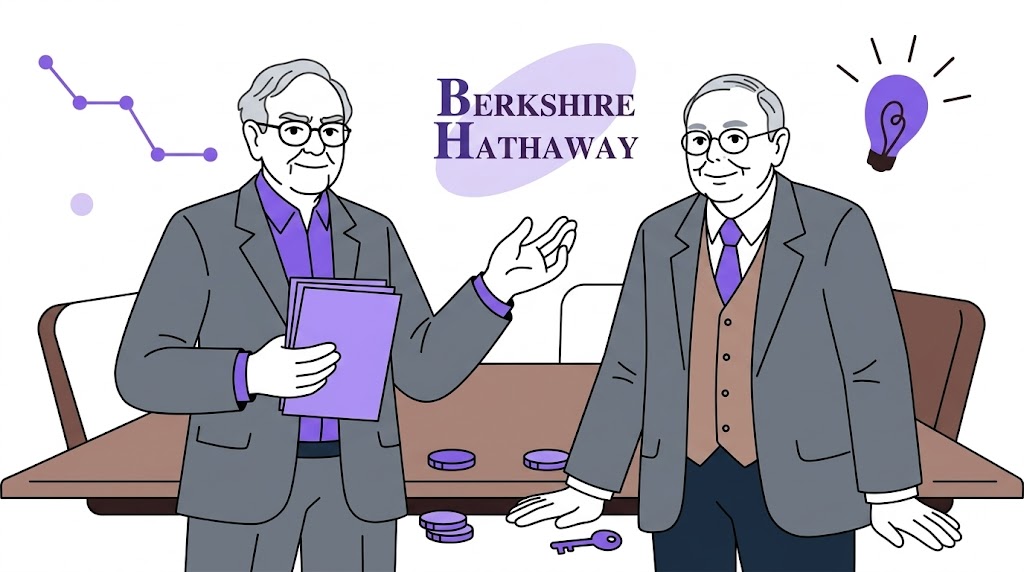
Opposites for 60 Years, Yet Not a Single Argument: Inside the Buffett–Munger Partnership
A spear and a shield are usually wielded by opponents. One pierces, the other deflects—a contest where if one wins, the other loses. But what if they were on the same team?
Think for a moment about someone you work with who pushes back on almost every idea you bring. Or perhaps you are that person—the one who answers "wait, let's look at this again" to nearly every proposal that crosses the table.
Two people exactly like that worked together for sixty years, and the result is one of the most successful companies in modern business: Berkshire Hathaway, built by Warren Buffett and Charlie Munger.
One Always Accelerated, One Always Hit the Brakes
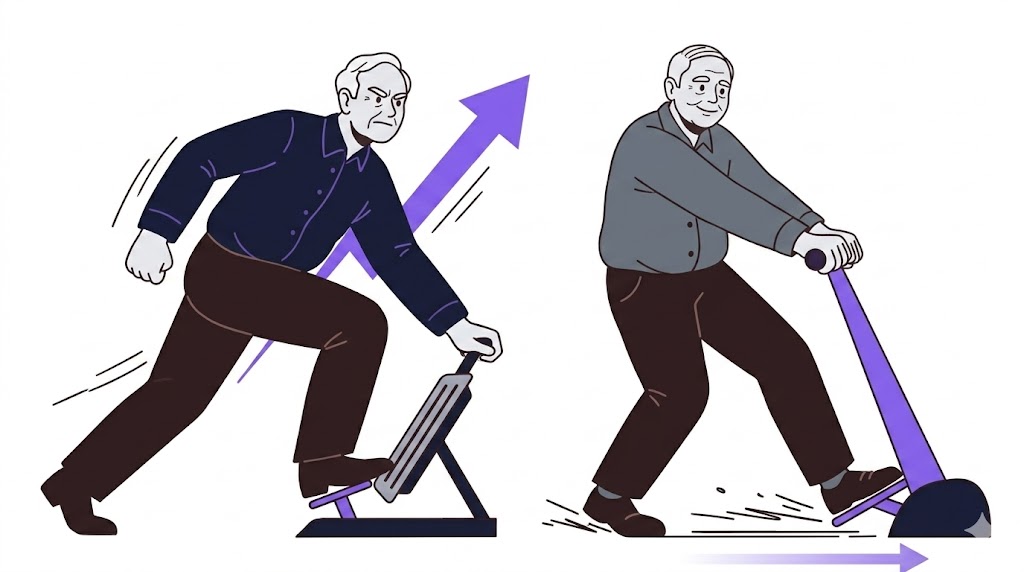
Warren Buffett and Charlie Munger first met in 1959. Buffett was 29, Munger was 35, and both happened to be from Omaha. They started working together, and over the next six decades they turned a struggling textile mill called Berkshire Hathaway into one of the most valuable investment companies in the world. But the way they worked could not have been more different.
Buffett was a man of action. When he saw a company he liked, he wanted to move quickly and acquire it. Munger was different. To nearly every proposal Buffett brought to him, Munger's answer was some version of "wait, let's look at this again." Whenever Buffett accelerated, Munger pulled the brake and forced another round of scrutiny.
Buffett gave Munger an affectionate nickname for this: "The Abominable No-Man." Munger said "no" so often—and so reflexively—that the label stuck as a running joke between them. One man accelerating, the other braking. Two opposite tempos in the same partnership.
And Yet, in Sixty Years, Not a Single Argument
Their collaboration lasted more than sixty years. What did that look like from the inside? Buffett himself put it best.
"Charlie and I have never had an argument. We've disagreed on a lot of things. And it's just never led, and never will, lead to an argument. We argue with other people." - Warren Buffett, 2014 Berkshire Hathaway Annual Shareholders Meeting
Disagreement was constant. But it never turned into conflict. How does a man who hits the gas and a man who hits the brakes work together for sixty years without ever clashing?
Opposites in Almost Everything—Except One Thing
Warren Buffett — Driver (D)
One-line definition The one who rallies the team's energy and carries it through to the goal.
Keywords Drive · Initiative · Goal-orientation · Performance · Passion
Strengths
Drives momentum so the team never stalls in front of its goal
Maintains pace so progress never stagnates
Delivers promised results through outcome focus
Cautions
Speed focus may overlook teammates' conditions
Preference for set methods makes spontaneous change harder to accept
Charlie Munger — Strategist (S)
One-line definition The one who anticipates future risks and designs a safer path forward.
Keywords Insight · Scenario thinking · Risk management · Structuring · Long-term vision
Strengths
Long-range scenarios prevent the team from getting stuck in short-term thinking
Identifies risks early to keep the team from repeating the same mistakes
Organizes priorities so the team stays aimed at the larger goal
Cautions
Extended thinking time can delay immediate action
Focus on the big picture can push aside on-the-ground response
Looking at this through the Work DNA lens, the differences become precise. Buffett is a Driver. He puts people first, takes immediate action, and operates within a clear set of principles. Munger was a Strategist. He put logic and the work first, insisted on thorough deliberation, and operated within the same kind of clear framework.
The two were opposites in almost every dimension. Different centers of gravity (people versus work), different decision speeds (act now versus think carefully). And yet on one dimension they were perfectly aligned: both worked within a defined system of principles. This is where everything turned.
Because both men anchored themselves to the same value investing framework, their differing centers of gravity could be negotiated in a shared language. If they had both been improvisers without a common system, their opposite tempos would have created friction at every turn. The shared framework absorbed the differences.
When One Strength Amplifies the Other
D-S Strengths
• Fast execution + big picture, working together: When D's drive pushes a decision forward, S's long-range scenarios point to the direction within the bigger picture
• Automatic risk review during momentum: As D accelerates, S surfaces risks early so the same mistakes don't repeat
• Both outcomes and priorities covered: D's outcome focus secures short-term wins while S's priority-setting secures long-term direction
• Shared collaboration language on common ground: Because both operate within defined principles, even their different centers of gravity can be negotiated in the same language
D-S Cautions
• Decision-pace gap (D acts immediately vs. S takes time to deliberate) → Divide pace by the size of the decision (small decisions follow D's speed; large decisions get S's deliberation time)
• Different center-of-gravity (D leans people·outcomes vs. S leans work·logic) → Build a process that runs decisions through both lenses (avoid concluding from one perspective alone)
• Crisis-mode pace clash (D's immediate response vs. S's careful analysis) → Agree in advance on which pace leads in crisis vs. routine situations
Buffett's strength is drive. He carries decisions through to completion so that the team never stalls in front of its goals. Munger's strength was long-range scenario thinking. By stepping outside the immediate horizon and identifying risks early, he made sure the same mistakes did not get repeated. When drive meets long-range thinking, fast execution and the big picture can operate at the same time.
There was, however, one area where they had to negotiate: decision tempo. Buffett preferred to convert decisions into action immediately. Munger preferred to take the time he needed to think things through. How did they handle the tempo gap? On smaller decisions, Buffett's speed set the pace. On larger decisions, Munger's deliberation got the runway it needed. Neither pace was forced on the other—the size of the decision quietly determined whose tempo led.
Buffett offered his own framing for what they had built together:
"In reality, Charlie was the 'architect' of the present Berkshire, and I acted as the 'general contractor' to carry out the day-by-day construction of his vision." - Warren Buffett, 2023 Berkshire Hathaway Shareholder Letter
One designs. The other builds. They never stood in the same spot, but they were always building the same building.
Earlier, we asked: do you have a colleague who pushes back on every idea you bring? Or are you that colleague to someone else? If the two of you find that your strengths operate in different territories and at different moments, you may well be a pair of spear and shield. And that is where a sixty-year synergy can begin.