
.png&w=1080&q=75)

.png&w=2048&q=75)
Two Friends Who Make the Same Work at Opposite Paces: Lennon, McCartney, and the Beatles

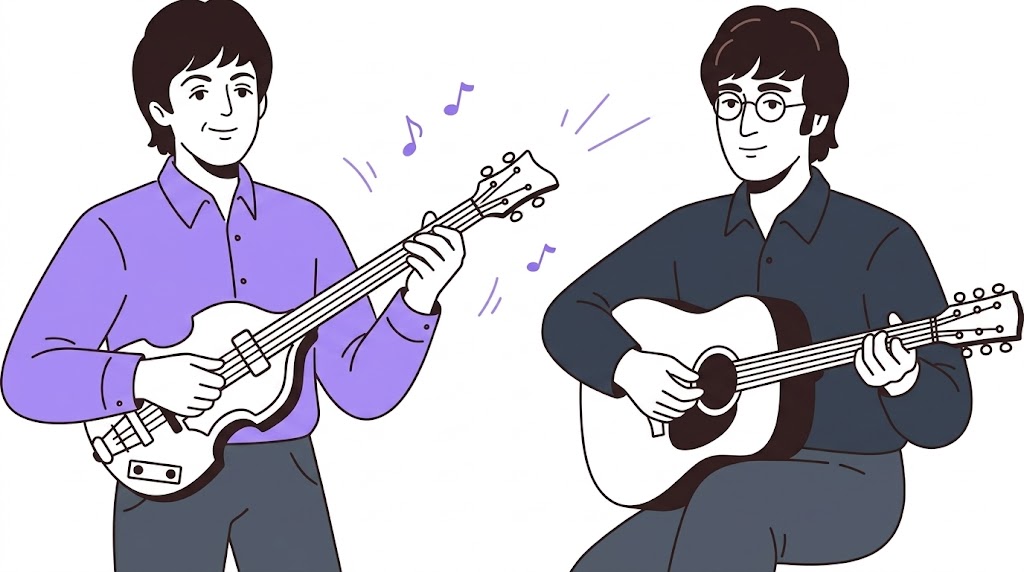
There's a song from 1967. "A Day in the Life." One person's reflective verse and another person's energetic middle section merged into one piece, and when you listen to it, the two different textures face each other within a single song like mirrors.
Those two were John Lennon and Paul McCartney. It's just one of the 180 or so songs the two wrote together for the Beatles, but everything about how they worked is captured in that one song.
One Started Songs from Reflection
John Lennon and Paul McCartney first met on July 6, 1957, at the St. Peter's Church fête in Woolton, Liverpool. Lennon was 16; McCartney was 15. Lennon's friend Ivan Vaughan brought McCartney to introduce him. After the performance, McCartney played Eddie Cochran's "Twenty Flight Rock" on guitar, and a few days later Lennon invited McCartney to join his band.
Before the Beatles became famous, the two made one agreement. No matter who wrote alone or together, every song would be credited under the joint name "Lennon-McCartney." About 180 songs went out into the world under that credit.
But their ways of writing diverged as time went on.
Lennon started his songs from reflection. In the autumn of 1966, while filming a movie in Spain, he wrote a song: "Strawberry Fields Forever." Strawberry Field was the garden of a Salvation Army children's home in Liverpool where he had played as a child. The song was about looking inward through the memory of childhood. The Beatles' producer George Martin, on first hearing it, called it a complete tone poem, like a modern Debussy.
Lennon's way of making a song was always the same. Take enough time to look inside himself, then translate the reflections that surface into lyrics and melody. He wasn't afraid of new forms, and tried something different every time. "Strawberry Fields Forever" took 45 hours in the studio, with three different versions merged into one. The song took five weeks to complete.
Starting from reflection, taking enough time to make something in a new shape—that was Lennon's way.
The Other Started Songs from Melody
John Lennon — Creator (C)
One-line definition The one who finds connections others overlook and opens up new possibilities.
Keywords Creativity · Originality · Reframing · Dimensional thinking · Insight
Strengths
Brings new possibilities so the team doesn't stay on the same path
Offers original perspectives and fresh solutions
Expands the range of what can be imagined
Cautions
Can linger in the ideation stage, making execution harder
Long thinking time may slow the pace when quick decisions are needed
Paul McCartney — Builder (B)
One-line definition The one who delivers promised results to completion with precision and craftsmanship.
Keywords Completeness · Precision · Responsibility · Execution · Detail
Strengths
Carries commitments through to the end
Finishes without missing details
Delivers the same quality consistently
Cautions
Pursuit of perfection can stretch the timeline
Improvising in response to unexpected variables is harder
If Lennon started songs from reflection, McCartney started from melody.
One day in 1965, McCartney woke up with a melody in his head. The melody felt so natural that for days he doubted whether he'd heard it somewhere before. He asked his friends, but no one knew the song. He had made it in his sleep.
That song was "Yesterday." One of the Beatles' most famous songs, and the song with more cover versions than any other in music history. McCartney took down the melody immediately by hand, and finished the song in days. The person who takes what arises in his head and immediately makes it with his hands—that was McCartney.
McCartney's songs always had the same texture. Natural melodies, palpable craftsmanship, structures anyone could sing along to. In late 1966, when Lennon brought "Strawberry Fields Forever," McCartney wrote "Penny Lane" in response. Penny Lane was an actual street in Liverpool he remembered from his childhood. The same childhood—Lennon sang his inner world, McCartney sang the scenes of the street.
The two songs were released together in 1967 as a double A-side single. Companion songs about the same childhood—one in reflection, the other in scene.
McCartney's way of making a song was always the same. When a melody arises, take it down immediately by hand, and refine the details into a work of finished craftsmanship. The intensity of focus on the work was the same as Lennon's, but the pace of executing was opposite.
When They Wrote Sitting Across from Each Other
C-B Strengths
• New vision + craftsmanship, working together: When C brings a new possibility, B turns that possibility into a finished work of high quality
• Shared intensity of focus on the work: Both put work and craft first, so the center of gravity for the work matches, and each understands the other's stance deeply (mirror signature: same center of gravity)
• Complementary opposite paces: B's immediate action fills C's careful deliberation, and B's craftsmanship refines C's new attempts
• Filling each other's gaps when working together: When working in the same place, what one cannot finish, the other can immediately pick up
C-B Cautions
• Thinking-pace clash (C's careful deliberation vs. B's immediate action) → Divide pace by stage (ideation stage at C's pace; execution stage at B's pace, by agreement)
• New attempts vs. craftsmanship friction (C is always trying something new vs. B operates within established systems) → Agree on decision criteria in advance (review the possibilities of new attempts fully, then clearly mark the stage of refining into finished craftsmanship)
• Friction between two people facing each other like mirrors (opposite paces can clash easily) → Recognize that the clash is not conflict but a resource for filling each other's gaps (the essence of mirror combinations is that difference becomes complementarity)
Even though their songs were so different, in the beginning they wrote in the same room together.
From 1962 to 1965, during the peak of Beatlemania, the two sat facing each other and wrote. Lennon called this way of working "Eyeball to Eyeball", looking eye to eye. One would throw out a melody, the other would catch it, throw it back, and through that rhythm one song after another came together. McCartney recalled later: "We never tried a writing session in those days that didn't result in a song."
Two friends sitting in the same chair to write songs together—that was where they started.
Through the Work DNA lens, the reason their rhythm worked becomes clear. Lennon is a Creator (C) type—someone who puts work and craft first, takes time to think, and enjoys new attempts every time. The essence is the architect who finds connections others overlook and opens new possibilities. Looking inward to write "Strawberry Fields Forever" and trying new forms—Lennon's essence.
McCartney is a Builder (B) type—someone who puts work and craft first, builds with his hands immediately, and delivers high-quality results within established systems. The essence is the executor who carries promised results all the way through. Taking down a melody from a dream to finish "Yesterday," refining melodies anyone could sing—McCartney's essence.
The two share the same center of gravity (both prioritize work and craft). Their intensity of focus on the work is similar. But their ways of thinking and ways of finishing faced each other like mirrors (Lennon: enough time to think and new attempts; McCartney: immediate action and craftsmanship).
Two people with the same center of gravity, making the same work at opposite paces. That's why, when they sat in the same chair to write, what one couldn't fill the other could fill immediately. When Lennon was lost in reflection and couldn't find a melody, McCartney immediately threw one out. When McCartney had built a finished melody, Lennon added a new form.
About 180 songs were born that way, in the same chair.
When They Filled In Each Other's Different Parts
As the Beatles moved into their later period, their ways of writing changed. The time they spent sitting across from each other shrank, and they shifted to bringing songs from their own places and combining them.
The change is most clear in the final song of their 1967 album Sgt. Pepper's Lonely Hearts Club Band: "A Day in the Life."
The song is split into two parts. Lennon's reflective verses, McCartney's energetic middle section. The two parts had started as completely different songs. Lennon had a reflective fragment inspired by newspaper articles; McCartney had an energetic fragment remembering his own childhood. The two combined those two fragments into one song.
One person's reflection flows into the other's energy, then circles back to reflection. Lennon's reflective verse and McCartney's energetic middle section face each other within one song like mirrors. The two different textures are fully present in a single song.
Had there been only Lennon, a song like "Yesterday" would not have come. Without McCartney's immediacy and craftsmanship, the other axis of Beatles music wouldn't exist. Had there been only McCartney, a song like "Strawberry Fields Forever" would not have come. Without Lennon's reflection and new attempts, the Beatles wouldn't have changed the form of music.
One person's reflection became the other's melody, and one person's new attempts were refined into the other's craftsmanship.
In the beginning they sat in the same chair and wrote together; later they combined parts each had made on their own. The way of collaboration evolved over time, but the fact that two people face each other within a song they made together did not change. Two people who give everything to the same work, meeting at opposite paces to complete a single song—that's one way good collaboration looks.