
.png&w=1080&q=75)

.png&w=2048&q=75)
The One Who Draws the Dream, and the One Who Makes It Possible: Walt, Roy, and 100 Years of Disney

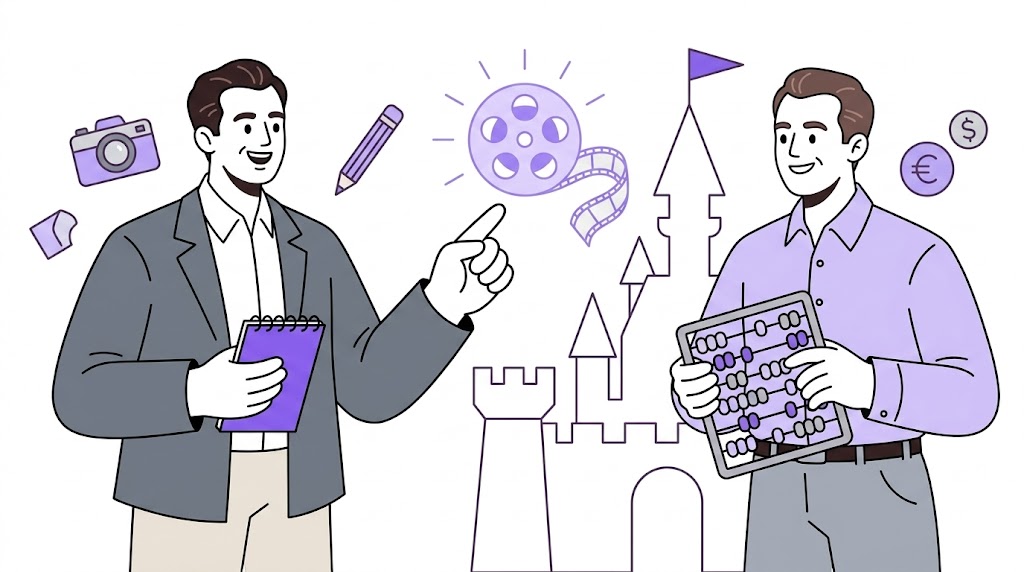
"If it hadn't been for my big brother, I swear I'd have been in jail several times for check bouncing." It sounds like a joke, but it was the warmest acknowledgment one person ever gave his older brother.
The younger brother was Walt Disney. The older brother was Roy Disney. The company they built together is Disney.
One Brother Drew the Dreams
Walt Disney drew from the time he was young. He started his first animation studio in Kansas City, but it went bankrupt. At 21, Walt was lost.
The place he got back on his feet was Los Angeles, and the one who pulled him there was his older brother Roy. In October 1923, the two brothers started a small studio with $500 borrowed from their uncle. The name was Disney Brothers Cartoon Studio. That was the beginning of Disney.
For the first few years, they survived on Alice Comedies, a series of live-action and animation hybrid shorts. In 1927, they created their first hit character: Oswald the Lucky Rabbit. The series was a major success. But in 1928, when Walt went to New York to renew the contract, he learned a shocking fact. The rights to Oswald belonged not to Disney but to Universal, the distributor. Most of his staff had been taken too.
On the train ride back to LA, Walt began drawing a new character: Mickey Mouse. That November, the sound-synchronized short Steamboat Willie premiered, and Mickey Mouse became an instant global star.
After that, Walt never stopped. In 1937, he made the world's first animated feature film with Snow White and the Seven Dwarfs. He pioneered color animation, the multiplane camera, and in 1955 he opened Disneyland—a theme park no one had ever attempted. What Walt did was always the same: open a new territory for the first time.
Walt has a famous line.
"Never forget that this whole thing started with a mouse." - Walt Disney
The one who brought new vision—that was Walt.
The Other Brother Made the Dreams Possible
If Walt was the one who drew the dreams, his 8-year-older brother Roy was the one who made them possible.
Even the start of Disney in 1923 was Roy's suggestion. The person who called the bankrupt brother from Kansas City to LA was his older brother. And the person who soon proposed changing the company's name from "Disney Brothers Cartoon Studio"—where both brothers' names appeared equally—to "Walt Disney Studio" was also Roy. He believed putting his brother's creativity at the front of the company was stronger. He yielded his own place for the company.
Roy's role was clear his entire life. When Walt dreamed of a new work, Roy arranged the financing and designed the contracts so that work could be operated as a company. If Walt was the originator of ideas, Roy was the one who built the environment where those ideas wouldn't disappear—where they could continue to be made.
The most important moment was Disneyland in the 1950s. When Walt said he wanted to build a theme park, Roy initially opposed it. Too risky, and could wreck the company's finances. But when Walt brought a financing plan through a partnership with ABC television, Roy agreed. And he went to New York himself to design the structure of the ABC contract. In 1955, Disneyland was an immediate success the moment it opened.
Walt had a joke he often told.
"If it hadn't been for my big brother, I swear I'd have been in jail several times for check bouncing." - Walt Disney
It sounds like a joke, but that's the real reason Disney has lasted to this day.
How Did the Brothers' Collaboration Continue
Walt Disney — Creator (C)
One-line definition The one who finds connections others overlook and opens up new possibilities.
Keywords Creativity · Originality · Reframing · Dimensional thinking · Insight
Strengths
Brings new possibilities so the team doesn't stay on the same path
Offers original perspectives and fresh solutions
Expands the range of what can be imagined
Cautions
Can linger in the ideation stage, making execution harder
Long thinking time may slow the pace when quick decisions are needed
Roy Disney — Facilitator (F)
One-line definition The coordinator who finds conclusions that satisfy everyone, balancing rules and care.
Keywords Smooth communication · Inclusiveness · Mediation · Stability · Cooperation
Strengths
Mediates opinions so no one feels excluded on the team
Balanced decisions prevent leaning to one side
Creates a stable environment where people can work without pressure
Cautions
Waiting for everyone's agreement can delay decisions
Caution about changes that disrupt balance can block new attempts
Just because brothers lead the same company doesn't mean their rhythms always align. Even people who grew up together create new conflicts when they work together.
Walt and Roy also had small disputes throughout their lives. But over the 40+ years they worked together, they reached agreement at every decisive moment. Through the Work DNA lens, the reason becomes clear.
Walt is a Creator (C) type—someone who puts work and craft first, takes time to think, and enjoys new attempts every time. The essence is the architect who sees possibilities others don't and opens new territories. Mickey Mouse, the first animated feature, the first theme park—every time, he was the first to make something no one had tried.
Roy is a Facilitator (F) type—someone who puts people and balance first, takes time to reach consensus, and operates within established systems. The essence is the coordinator who finds conclusions that satisfy everyone, balancing rules and care. Yielding the company name to his brother, designing the Disneyland financing structure himself—all of it is Roy's essence.
The two have different centers of gravity (Walt leans work, Roy leans people and balance). Their stance toward new attempts differs too (Walt is always trying something new; Roy is cautious about changes that might disrupt the balance). Only one thing was the same: taking time to reach agreement before deciding.
Walt didn't push new ideas through immediately. Even Disneyland was prepared for years, with a financing structure to persuade Roy, before it moved forward. And Roy didn't immediately oppose his brother's new attempts. He reviewed thoroughly, then agreed. Both spent time before deciding, and once decided, they didn't waver.
This is why the brothers' collaboration continued for 40 years. It took time to reach agreement, but once agreed, the decision went all the way through. That's also why Disneyland was an immediate success in 1955.
The One Who Draws the Dream, and the One Who Makes It Possible
C-F Strengths
• New vision + stable execution, working together: When C brings a new possibility, F operates that possibility within a stable system and environment
• Low-friction collaboration through full consensus: Both value reaching agreement, so there are fewer clashes before deciding and steady follow-through after (diagonal-R signature)
• Natural division between work·vision and people·balance: C takes responsibility for opening new territory; F takes responsibility for the stable environment of people and balance
• Aligned tempo of decision-making: Both spend time before deciding, so the depth of decisions matches and trust accumulates
C-F Cautions
• Slow decision pace (C's careful deliberation + F waiting for everyone's agreement) → Divide pace by the size of the decision (major decisions get full time; smaller decisions get pre-delegated for speed)
• Center-of-gravity difference (C leans work·vision vs. F leans people·balance) → Build a process that runs decisions through both lenses (avoid concluding from one perspective alone)
• New attempts vs. stability clash (C is always trying something new vs. F is cautious about changes that disrupt balance) → Progress in stages of consensus (review the possibility of new attempts fully, then design a stable execution structure)
Had there been only Walt, Disney might not have endured as a company. Walt was someone who endlessly opened new territories, but running those territories as a company was a different kind of work.
Had there been only Roy, there would have been no new works for the company to run. Roy was someone who ran the company, but the one who first drew Mickey Mouse and Disneyland was his brother.
One brother drew the dream, and the other made the dream possible.
When Walt passed away in 1966, the Florida theme park he had last dreamed of was still unfinished. Roy postponed his retirement and spent five years completing his brother's dream himself. At the opening ceremony in October 1971, Roy named the park not after himself but Walt Disney World. The original plan had been Disney World, but he wanted to add his brother's name. Two months later, Roy followed his brother.
Recall Walt's lifelong joke. "If it hadn't been for my big brother, I swear I'd have been in jail several times for check bouncing." It was a joke, but it was true for life.
When someone draws a dream and another person is beside them to make that dream possible, the dream becomes a company, becomes a film, becomes a place that people still visit 100 years later. The two places of good collaboration face each other like that.