
.png&w=1080&q=75)

.png&w=2048&q=75)
A Path Opened by One Generation, Taken Worldwide by the Next: Chung Ju-yung, Chung Mong-koo, and Hyundai
A few days ago, a Korean automaker scored its first points on the world's top auto racing stage—the very stage where Ferrari, Toyota, and BMW compete. The team was Genesis Magma Racing, Hyundai's high-performance brand. Just one generation ago, this company's cars were mocked overseas as "cheap electronics on wheels."
How did it get here? The answer lies in something invisible that two people passed down and inherited. This is the story of Chung Ju-yung, who founded the Hyundai Group, and his second son Chung Mong-koo, who grew Hyundai Motor into the fifth-largest automaker in the world.
One Person Opened the Path
Chung Ju-yung was born into a poor farming family in Tongcheon, Gangwon Province. He had no education and no inherited capital. The one thing he had was an attitude: "Let's try."
The Hyundai founder's most famous line goes like this.
"Hey, have you even tried it?" — Chung Ju-yung
Whenever someone said "It can't be done," Chung would ask this in return. The meaning was simple: don't say it's impossible before you've tried.
In the 1970s, when he went to a foreign bank to borrow money without owning a single shipyard, he pulled out a 500-won note with a turtle ship printed on it. "We are a people who built ironclad warships 300 years before Britain," he argued. With those words he secured the loan, and with that money he built a shipyard in Ulsan.
It was the same with automobiles. In the 1960s, there was nothing in Korea you could call an auto industry. Chung started with a Ford joint venture, but soon resolved to build a car of their own rather than relying on someone else's technology. Everyone said, "What does Korea know about making cars?" Chung asked the same thing in return: "Have you tried it?"
Chung was someone who tried immediately without a manual, and found a path on the spot when variables arose. Automobiles, shipbuilding, construction—he opened industries that didn't exist in Korea with his bare hands. On the path he opened, the next generation could run.
The Other Person Took That Path Worldwide
If Chung Ju-yung opened the path, his second son Chung Mong-koo took it worldwide.
In 1999, Chung Ju-yung handed the group's automobile division to Chung Mong-koo. At that time, overseas evaluations of Korean cars were still low—the perception was of cheap cars that broke down quickly.
Chung Mong-koo's strategy was clear: quality. He made "quality management" his core principle and built the Namyang R&D Center to secure key technology directly. That same year he acquired Kia to build scale, and he established production and sales systems step by step across the US, Europe, India, and China.
The result was remarkable. In 2010, Hyundai overtook Ford to reach fifth place in global vehicle sales. A company once mocked as "cheap electronics on wheels" had become, in just over a decade, a manufacturer the world recognized. Chung Mong-koo became the first Korean inducted into the Automotive Hall of Fame in the United States.
What Chung Mong-koo did was not to open a new industry for the first time. It was to take the path his father opened and widen it to the world market with unwavering systems and quality. The drive to execute immediately was the same as his father's, but turning that execution into a global quality system was Chung Mong-koo's own way.
How Did the Father-Son Collaboration Continue
Chung Ju-yung — Adapter (A)
One-line definition The one who finds immediate solutions in unpredictable situations.
Keywords Quick-thinking · Improvisation · Flexibility · Intuition · Situational response
Strengths
Speeds the team's recovery when variables hit
Finds new ways through dead ends by improvising
Turns crises into opportunities through rapid adaptation
Cautions
Reliance on improvisation can blur long-term planning
Disrupting set methods can throw off other teammates' rhythm
Chung Mong-koo — Driver (D)
One-line definition The one who rallies the team's energy and carries it through to the goal.
Keywords Drive · Initiative · Goal-orientation · Performance · Passion
Strengths
Drives momentum so the team never stalls in front of its goal
Maintains pace so progress never stagnates
Delivers promised results through outcome focus
Cautions
Speed focus may overlook teammates' conditions
Preference for set methods makes spontaneous change harder to accept
A father and son leading the same company doesn't always mean their rhythms align. Generations differ, eras differ, and ways of working differ too.
But Chung Ju-yung and Chung Mong-koo shared one thing. Through the Work DNA lens, that common ground becomes clear.
Chung Ju-yung is an Adapter (A) type—someone who puts work and results first, moves immediately on instinct without a manual, and finds a new path on the spot when variables arise. The essence is the problem-solver who finds immediate solutions in unpredictable situations. Securing a loan with a turtle-ship banknote, opening industries that didn't exist in Korea with his bare hands—all of it is Chung Ju-yung's essence.
Chung Mong-koo is a Driver (D) type—someone who puts people and the field first, acts immediately, and carries the goal through to the end within established systems. The essence is the driver who gathers the team's energy and never stops short of the goal. Making quality management his core and pushing the global production-and-sales system through to the end—all of it is Chung Mong-koo's essence.
The two have different centers of gravity (Chung Ju-yung leans work and results; Chung Mong-koo leans people and the field). Their stance toward new attempts differs too (Chung Ju-yung makes new paths without a manual; Chung Mong-koo expands within established systems). Only one thing was the same: acting immediately.
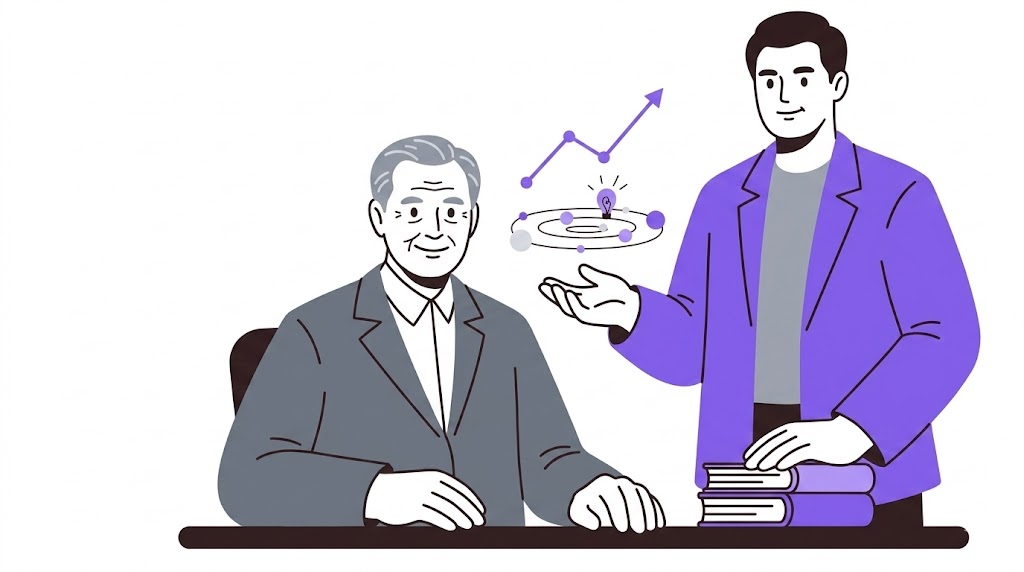
This is why the father-son collaboration continued so naturally. When Chung Ju-yung said "Have you tried it?" and threw himself immediately into a new industry, Chung Mong-koo also threw himself into the global market without hesitation. When one opened a path immediately, the other ran it immediately. The direction of their thinking differed, but the speed of their action was the same.
On the path the father opened, the son ran at the same speed.
One Generation's Path Becomes the Next Generation's Starting Point
A-D Strengths
• Immediate action + drive, working together: When A opens a new path immediately, D pushes that path all the way to the goal
• Never stalls, even at dead ends: A's quick-thinking clears the variables, and D's drive breaks through the stagnation
• Aligned tempo of immediate action: Both move immediately, so the gap between decision and execution stays short (diagonal-A signature)
• Natural division between pioneering and goal-reaching: A takes responsibility for new possibilities and variable response; D takes responsibility for driving toward the goal and delivering results
A-D Cautions
• Center-of-gravity difference (A leans work·results vs. D leans people·field) → Build a process that runs decisions through both lenses (avoid concluding from one perspective alone)
• New attempts vs. established systems clash (A improvises without a manual vs. D prefers established systems) → Divide roles by stage (pioneering new ground: A; systematic expansion: D)
• Risk of both focusing on speed (A's reliance on improvisation + D's focus on speed) → Assign long-term planning and team-condition checks separately (deliberately tend to what's easy to miss amid fast execution)
Had there been only Chung Ju-yung, Hyundai might have remained a Korean company. Chung Ju-yung was someone who opened industries that didn't exist, but turning that industry into a global quality system was a different kind of work.
Had there been only Chung Mong-koo, there would have been no path to widen at all. Chung Mong-koo was someone who widened the path to the world, but the one who first opened it was his father. Without someone who started the auto industry with his bare hands, there would have been no company to take global.
One generation's challenge became the next generation's starting point. Chung Ju-yung's pioneering spirit created the starting point called Hyundai, and Chung Mong-koo's quality management raised that company to fifth in the world. And that path continues even now—like Genesis Magma, which scored its first points on the world racing stage just days ago.
Of all the things we inherit from our parents, the largest is often invisible. What Chung Mong-koo inherited from his father was not a company as property, but the attitude of "trying it right away." On top of that attitude, Chung Mong-koo grew the company in his own way—through quality and systems.
Had he merely preserved what he inherited, Hyundai would have stayed where it was. Because he added his own way on top of the attitude he inherited, the company could move to the next place. Good succession is not about carrying things forward unchanged, but about adding your own on top of what you inherited.