
.png&w=1080&q=75)

.png&w=2048&q=75)
The Day Two Friends Decided to Build a Company: Jobs, Wozniak, and Apple

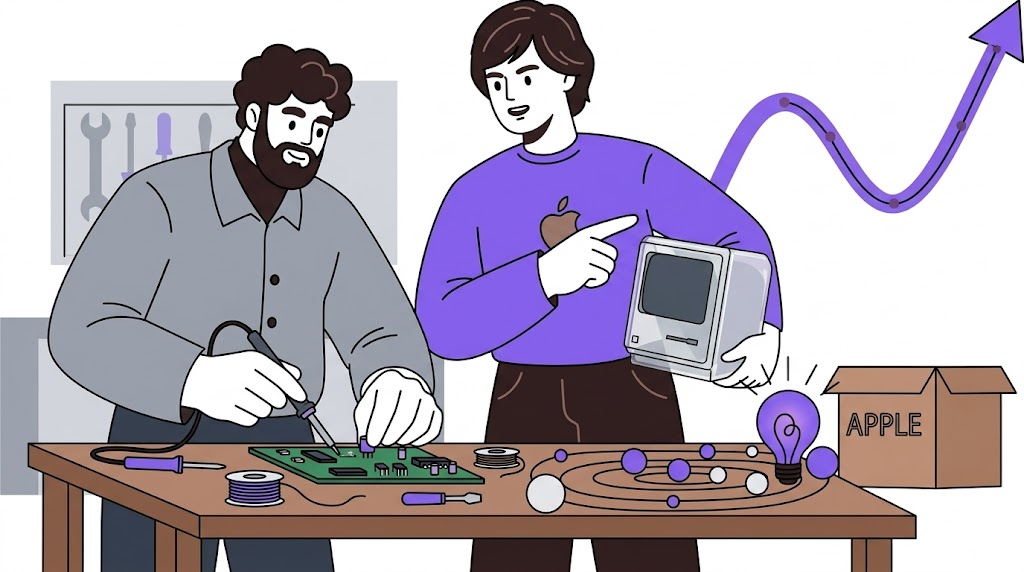
A few weeks ago, a 50-year veteran engineer stood on a graduation stage and said: "You all have AI—actual intelligence." In an era when artificial intelligence seems poised to replace everything, he still sees humans as standing above the technology. And when he built a company in a garage with one friend fifty years ago, what grew that company was, in the end, the collaboration between two people.
The two we're looking at today are the two Steves who built Apple in a garage fifty years ago—Wozniak and Jobs.
One Person Wanted to Give His Invention Away for Free
Wozniak completed the design of the Apple I in 1975. The first thing he did with this brilliant computer was to share its schematics freely at the Homebrew Computer Club. He even went to other people's houses to help them build their own copies.
Fifty years later, in his May 2026 commencement speech, Woz himself answered why.
"When we started Apple, did I want to make money? Start a company? Start an industry? No. I wanted other engineers or other computer people to look at my designs and say, 'Whoa,' and appreciate me and my brilliance." - Steve Wozniak, GVSU commencement speech (2026)
Wozniak had no intention of starting a company from the beginning. What he wanted was not money, not a company, not an industry—but the recognition of fellow engineers.
In fact, Woz first offered his design to HP. As an HP employee, he was obligated to show his inventions to his employer first. He presented the Apple I design to HP five separate times. HP turned it down all five times. Had HP accepted even once, Woz would have built that computer as an HP employee, and Apple would not have existed. HP's refusal set Woz's design free.
The Other Person Wanted to Turn That Invention Into a Company
At the same time, Woz had a friend he had known for five years. Steve Jobs.
The two first met in 1971. Woz was a 21-year-old college student; Jobs was a 16-year-old high schooler. A mutual friend, Bill Fernandez, introduced them with the suggestion, "There's someone who's into electronics and pranks—you should meet."
Over those five years, the two had worked on small projects together. In 1971, they built the Blue Box—a device that enabled free long-distance phone calls—and sold it at Berkeley dormitories. In 1973, when Jobs got a circuit design job from Atari, he asked Woz to help him work on the Breakout game. These weren't big businesses, but the pattern was always the same: Woz built it, and Jobs took it to market. The two had spent five years naturally falling into that rhythm.
So in 1976, when Jobs saw the schematics of the Apple I, his reaction was clear: "This could be a company." He genuinely recognized Woz's genius.
Jobs persistently tried to persuade Woz to start a company. Woz initially refused. He planned to work at HP for life and had no interest in business. But the line Jobs delivered at the end moved Woz. It appears in Woz's autobiography, iWoz.
"Even if we don't succeed, at least we can tell our grandchildren that we had our own company once." - Steve Jobs's pitch to Wozniak (Wozniak, iWoz)
It wasn't a promise of success—it was a promise of a shared memory. Five years of friendship had built the trust that made that pitch land. On April 1, 1976, the two founded Apple Computer in Jobs's parents' garage.
Why Did the Two Decide to Do It Together
Steve Wozniak — Builder (B)
One-line definition The one who delivers promised results to completion with precision and craftsmanship.
Keywords Completeness · Precision · Responsibility · Execution · Detail
Strengths
Carries commitments through to the end
Finishes without missing details
Delivers the same quality consistently
Cautions
Pursuit of perfection can stretch the timeline
Improvising in response to unexpected variables is harder
Steve Jobs — Driver (D)
One-line definition The one who rallies the team's energy and carries it through to the goal.
Keywords Drive · Initiative · Goal-orientation · Performance · Passion
Strengths
Drives momentum so the team never stalls in front of its goal
Maintains pace so progress never stagnates
Delivers promised results through outcome focus
Cautions
Speed focus may overlook teammates' conditions
Preference for set methods makes spontaneous change harder to accept
What if Woz had simply shared his design for free? The schematics from the Homebrew Computer Club would have circulated among hobbyists for a while. A few people would have built their own copies and kept them at home. With time, someone else might have recognized the design's value and built a similar company. The computer revolution would have come in some form. It just would not have been Apple, and it might have come later.
The reason Woz agreed to go together was, ultimately, because Jobs was the friend who took his invention seriously.
If Jobs alone had told Woz to start a company, Woz might have refused. But there were five years of accumulated time between them. The experience of selling Blue Boxes together, of working on the Atari Breakout together. They weren't big ventures, but Jobs had spent five years building the rhythm of taking Woz's designs to market.
Through the Work DNA lens, the roles of the two become clear. Jobs is a Driver (D) type—someone who puts people first, acts immediately, and operates within established systems. The essence is the drive to pull together people and markets with a vision. Woz is a Builder (B) type—someone who puts work and craft first, builds with his hands immediately, and operates within established systems. The essence is the executor who delivers high-quality results all the way through.
The two have different centers of gravity (people·market vs. work·completeness). But two things were the same: acting immediately, and operating within established systems. That's why, over five years of small projects, their rhythm came together naturally. One builds; the other immediately takes it to market.
So the founding of the company on April 1, 1976, was not a sudden decision—it was a conclusion reached naturally over five years.
One Person's Strength Becomes Another Person's Starting Point
B-D Strengths
• Vision + completeness, working together: When D's vision sets the direction, B carries it through to completion with quality
• Aligned tempo of immediate action: Both put their hands on the work right away, so the gap between decision and execution stays short
• Collaboration on shared structure: Because both operate within agreed-upon principles, even different centers of gravity can be negotiated in the same language
• Natural division between market and product: D takes responsibility for the market and people; B takes responsibility for the product and technology
B-D Cautions
• Center-of-gravity difference (D leans people·market vs. B leans work·completeness) → Build a process that runs decisions through both lenses (avoid concluding from one perspective alone)
• Speed vs. completeness tempo clash (D pushes for quick results vs. B pursues full completeness) → Agree in advance on the balance between deadline and quality (acknowledge that not everything needs the same level of polish)
• User vs. technology priority difference (D prioritizes user experience vs. B prioritizes technical accuracy) → Build a process where both perspectives meet in product decisions (user testing + technical validation together)
Had there been only Woz, the Apple I would have ended as a schematic. It would have remained a legendary design at the Homebrew Club, but there would have been no company that started in a garage and grew to a $4 trillion market cap. Had there been only Jobs, the Apple I itself wouldn't have existed. Jobs wasn't an engineer. The reason he could tell Woz "this could be a company" was because Woz had already built that computer.
One person's strength became another person's starting point. Woz's completeness made Jobs's vision possible, and Jobs's drive carried Woz's design to market.
But there were also differences between them. Jobs focused on people and the market; Woz focused on the work and the technology. Their perspectives often diverged in the same decisions. How did they handle it? Jobs took responsibility for the market and people territory; Woz took responsibility for the technology and product territory. They didn't clash in the same area—each worked at their own pace where they were strongest.
The place where someone's strength becomes another's starting point—that's the place where good collaboration begins.